
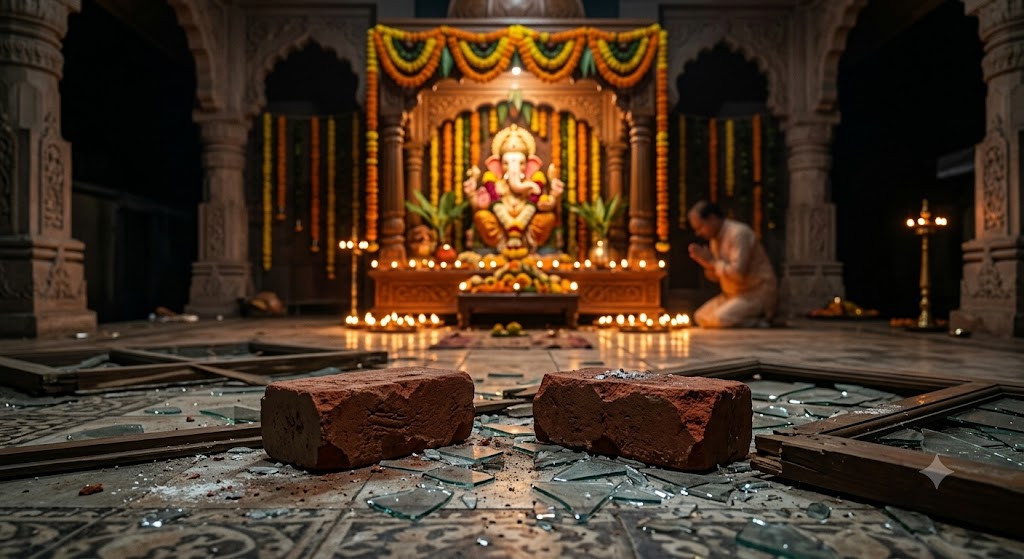
Places of worship are universally regarded as sanctuaries—safe havens for spiritual reflection, community gathering, and peaceful devotion. When that fundamental sense of security is violently breached, the shockwaves resonate far beyond the walls of the targeted building. On a seemingly ordinary Friday afternoon, the Indian-American diaspora was once again forced to confront the rising tide of targeted hostility in the United States. In a brazen and terrifying act of vandalism, the Shree Swaminarayan Vadtal Dham Hindu Mandir in Ohio was attacked with bricks while priests and devotees were actively gathered inside.
As the glass shattered and the community reeled from the sudden violence, the incident has laid bare a disturbing, escalating pattern of attacks against Hindu places of worship across North America. This is no longer merely a localized issue of property damage; it has evolved into a pressing national conversation about religious freedom, minority protection, and the urgent need for federal intervention against hate crimes.
The Friday Attack: Terror Inside the Sanctuary
The attack unfolded at approximately 1:30 PM local time on Friday in Richmond Heights, a city in the Greater Cleveland area of Ohio. According to reports from community leaders and advocacy organizations, unidentified perpetrators approached the Shree Swaminarayan Vadtal Dham Hindu Mandir and began hurling heavy bricks directly at the building.
The sheer force of the projectiles caused significant structural damage, shattering multiple large windows across the temple’s facade. But the most chilling detail of this incident is not the physical destruction—it is the timing. Unlike many instances of vandalism that occur under the cover of darkness, this attack was executed in broad daylight while the temple was occupied. The Coalition of Hindus of North America (CoHNA) confirmed that priests and devotees were present inside the building, conducting their daily routines and spiritual duties when the bricks came crashing through the glass.
Fortunately, there have been no physical injuries reported from the scene. However, the psychological trauma inflicted upon the devotees who experienced the sudden, violent breach of their sacred space is profound. Local law enforcement swiftly responded to the scene, and authorities are currently conducting a forensic review of the temple’s surveillance video footage to identify the assailants.
Advocacy Groups Mobilize: A Call for Federal Action
The immediate aftermath of the attack has seen a massive, coordinated mobilization by Indian-American and Hindu advocacy groups demanding accountability and federal oversight. The Hindu American Foundation (HAF), a prominent non-profit advocacy organization, rapidly detailed the incident on social media platform X, categorizing the terrifying assault as a “possible hate crime”.
Given the severity of the attack and the presence of people inside the building, the HAF has officially alerted both the FBI and the Civil Rights Division of the Department of Justice. The foundation is maintaining direct contact with the temple’s leadership, offering comprehensive legal and community assistance to navigate the aftermath.
In a powerful statement, the HAF emphasized the broader societal climate, noting that this possible hate crime “comes at a time of unprecedented hate and vitriol directed at the Hindu American community”. They have urgently requested that law enforcement agencies elevate the apprehension of the perpetrators to a top priority.
Similarly, CoHNA has stepped up its advocacy, placing direct pressure on local political leadership. The coalition has explicitly urged Richmond Heights Mayor Kim Thomas, along with municipal and city authorities, to publicly and unequivocally condemn the incident. For minority communities facing targeted harassment, silence from elected officials is often interpreted as complicity. A swift, public denunciation from city leadership is considered a vital first step in reassuring the local diaspora that their safety is a civic priority.
A Dark Shadow Over Hindu Heritage Month
The timing of the Richmond Heights attack is particularly cruel, casting a dark shadow over what is traditionally a period of immense joy and cultural celebration for the diaspora. Every October, Hindu community organizations across the United States observe Hindu Heritage Month, a dedicated time to celebrate the rich spiritual, cultural, and economic contributions of the community to the American fabric.
Furthermore, the temple was in the final stages of preparation for Navratri, one of the most significant and widely celebrated festivals in the Hindu calendar, honoring the Divine Feminine. The festival, due to begin in less than ten days, typically draws massive crowds for nightly prayers, traditional music, and Garba dances.
Attacking a community hub just days before a major religious festival is a classic intimidation tactic designed to instill fear and suppress public cultural expression. Instead of focusing entirely on festive preparations, the temple administration and local devotees are now forced to divert their attention and resources toward boarding up shattered windows, coordinating with federal investigators, and hiring private security to ensure the safety of their congregation during the upcoming holy days.
A Documented Pattern of Escalating Hostility
The most alarming aspect of the Ohio attack is that it does not exist in a vacuum. It is the latest data point in a highly documented, recurring pattern of vandalism and intimidation targeting Hindu temples across the United States and broader North America.
Over the past few years, the frequency and brazenness of these attacks have surged. In September 2024, BAPS Swaminarayan temples in Melville, New York, and the Sacramento area of California were both subjected to severe vandalism. Just months later, in March 2025, another BAPS temple located in Chino Hills, California, was defaced, with attackers leaving behind hateful messages specifically targeting the Hindu community.
These incidents often feature a mix of physical destruction and the spray-painting of offensive, xenophobic, or politically motivated graffiti on sacred walls. The cumulative effect of these repeated attacks is a creeping sense of vulnerability among the Indian-American diaspora—a community that is highly educated, economically prosperous, and deeply integrated into the American professional landscape, yet increasingly finds itself in the crosshairs of targeted hate.
The Road Ahead: Defending the Sanctuaries
As the FBI and local authorities in Ohio hunt for the perpetrators of Friday’s brick attack, the conversation must shift toward proactive protection. Federal law enforcement agencies must recognize this string of temple attacks not as isolated acts of local vandalism, but as a coordinated or ideologically driven pattern of domestic hate crimes requiring a robust, systemic response.
For the American political establishment, this is a moment that demands absolute moral clarity. Bipartisan leadership across all levels of government must forcefully reject the normalization of xenophobia and ensure that adequate federal funding is allocated to secure places of worship for minority religions.
The Indian-American community, meanwhile, continues to demonstrate remarkable resilience. While the shattered glass at the Shree Swaminarayan Vadtal Dham Hindu Mandir serves as a grim reminder of the challenges they face, the upcoming Navratri celebrations will undoubtedly go forward. The most potent response to those who hurl bricks in an attempt to shatter a community’s spirit is to rebuild, gather in greater numbers, and ensure that the light of the sanctuary remains undimmed.
* Conceptual illustration generated using AI