
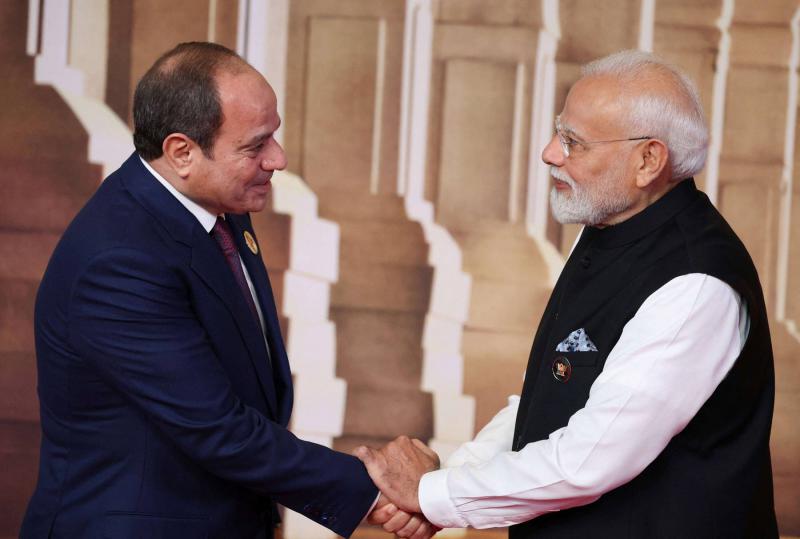
India and Egypt are seeking to give greater economic depth to their strategic partnership, with President Abdel Fattah al-Sisi and Prime Minister Narendra Modi placing trade, investment and private-sector cooperation at the centre of their latest discussions. The two leaders reviewed ways to build on the steady expansion of bilateral relations since the countries elevated their ties to a strategic partnership in 2023, while identifying new opportunities for businesses and investors on both sides.
Their meeting took place on the sidelines of the BRICS summit in New Delhi and highlighted a shared ambition to move the relationship beyond traditional political and diplomatic engagement towards a broader and more commercially integrated partnership. Both sides are looking to strengthen investment flows, expand industrial cooperation and encourage greater participation by the private sector.
A key objective is to significantly increase bilateral trade. India and Egypt are targeting trade of $12 billion within five years, a goal that reflects the confidence both governments place in the potential of their economic relationship. Bilateral trade stood at $6.5 billion during the 2025–26 financial year, according to the Indian Embassy in Egypt, leaving considerable room for expansion over the coming years.
For Egypt, attracting greater investment from Indian companies has emerged as a central element of this strategy. President Sisi encouraged Indian businesses to increase their presence in Egypt, highlighting the country’s strategic geographical location, skilled workforce, network of free trade agreements and the incentives available through the Suez Canal Economic Zone and other industrial areas.
Egypt positions itself as a regional manufacturing hub
Cairo’s economic pitch is based not only on the size of the Egyptian market but also on the country’s position as a gateway to several major regions. Situated at the crossroads of Africa, the Middle East, Europe and Asia, Egypt offers Indian companies the potential to establish manufacturing and export operations that can serve markets beyond the country itself.
The Suez Canal Economic Zone is particularly important to this strategy. Located alongside one of the world’s most important maritime trade routes, the zone combines industrial infrastructure with logistics and transport advantages. For companies seeking to establish regional supply chains, its proximity to major shipping routes can reduce logistical barriers and improve access to international markets.
Egypt’s network of trade agreements provides another attraction for investors. By producing within Egypt, Indian companies can potentially access not only domestic consumers but also wider markets across Africa, the Middle East and other regions covered by Egypt’s trade arrangements.
This makes Egypt an increasingly attractive proposition for companies seeking to diversify manufacturing and establish regional production bases. For New Delhi, deeper investment in Egypt could simultaneously strengthen bilateral economic ties and provide Indian companies with a platform for expanding their global and regional footprint.
Modi encourages greater business engagement
Prime Minister Narendra Modi backed Egypt’s efforts to attract greater Indian investment and encouraged Indian companies to explore opportunities in the country. He also called for stronger interaction between the business communities of India and Egypt.
Greater private-sector engagement could help transform the political momentum between the two countries into concrete commercial projects. Closer links between companies, investors and industry bodies could facilitate joint ventures, promote technology and expertise sharing, and open new channels for long-term investment.
For India, stronger commercial engagement with Egypt also fits into its broader efforts to expand the international reach of Indian companies and strengthen economic relationships with key partners in Africa and the Middle East.
The private sector could therefore become an important bridge between the strategic objectives of the two governments and the practical expansion of bilateral commerce. Joint projects, local manufacturing and technology partnerships could provide a more sustainable foundation for trade growth than a relationship based primarily on the exchange of finished goods.
Manufacturing offers scope for long-term cooperation
Manufacturing is one of the areas where both sides see particularly strong potential. Egypt is seeking to increase domestic production, strengthen its industrial base and expand exports, while Indian companies possess extensive experience in manufacturing and established capabilities across a range of sectors.
Greater Indian participation in Egyptian manufacturing could support the country’s industrialisation goals while allowing Indian firms to take advantage of Egypt’s geographic position and access to regional markets.
The automotive industry is another promising area. India’s well-developed automotive manufacturing ecosystem and experience in producing vehicles and components at scale could complement Egypt’s efforts to develop its own automotive sector and attract additional manufacturing investment.
Investment in automotive production could have a wider impact than simply increasing bilateral trade in vehicles. Establishing manufacturing facilities and component supply chains in Egypt could support local employment, technology transfer and the development of industrial capabilities, while providing Indian companies with a potential export base for neighbouring and other international markets.
This approach would help both countries shift towards deeper production partnerships rather than relying primarily on conventional trade in finished products.
Technology and digital cooperation
Technology is another major area where India and Egypt can expand cooperation. India’s globally recognised capabilities in information technology, software and digital services could support Egypt’s efforts to develop higher-value industries and strengthen its digital economy.
Indian technology companies could find opportunities in areas ranging from information technology services to digital infrastructure and business solutions. At the same time, Egyptian companies and institutions could benefit from partnerships that provide access to Indian expertise, technology and experience.
Greater technological cooperation could also contribute to broader economic objectives by supporting the development of skilled employment and strengthening the integration of digital technologies across industries.
As both countries seek to modernise their economies, collaboration in technology offers the possibility of building new areas of commercial engagement alongside traditional sectors such as manufacturing and trade.
Clean energy and green hydrogen emerge as new opportunities
Clean energy is another sector gaining importance in India–Egypt economic relations. Both countries are exploring opportunities in renewable energy and green hydrogen as they seek to expand cleaner sources of power and respond to the global shift towards lower-carbon economies.
For Egypt, Indian investment could help support the financing and development of renewable energy projects and contribute to its ambition of expanding its clean-energy capacity.
For Indian companies, Egypt presents a potentially attractive market for renewable energy and related infrastructure, supported by growing regional demand for energy. The country’s location could also make it relevant to wider energy and green-fuel supply chains linking Africa, Europe and the Middle East.
Green hydrogen, in particular, has the potential to become a strategically important area of cooperation as countries look to develop alternative sources of energy and reduce emissions. Collaboration between Indian and Egyptian companies could support technology transfer, investment and the development of new clean-energy projects.
Pharmaceuticals add another industrial dimension
Pharmaceuticals also offer scope for greater economic cooperation. The sector adds a further industrial dimension to bilateral ties and builds on India’s established strengths in pharmaceutical manufacturing and healthcare-related industries.
Greater cooperation could involve investment, manufacturing partnerships and technology sharing, potentially allowing Indian companies to expand their presence in Egypt while contributing to the country’s domestic industrial capabilities.
For Egypt, attracting pharmaceutical manufacturing investment fits into its broader objective of strengthening strategic industries and increasing domestic production. For India, partnerships in this field could open access to regional markets and create opportunities for companies seeking to expand their manufacturing and distribution networks.
Strategic geography strengthens economic case
The economic partnership between India and Egypt is also being shaped by the wider geopolitical and strategic importance of both countries.
Egypt’s geographical position gives India an important gateway into Africa and the Middle East. Its location around the Suez Canal connects major maritime trade routes and places the country at the centre of global commerce.
India, meanwhile, offers Egypt access to one of the world’s largest consumer markets and one of the fastest-growing major economies. Strengthening economic ties with India can help Cairo expand its commercial links with South Asia while attracting investment, technology and industrial partnerships.
This geographic complementarity provides a strong foundation for the two countries to pursue a more ambitious economic partnership.
BRICS provides another platform for cooperation
The India–Egypt relationship is also gaining a multilateral dimension through BRICS. Egypt became a full member of the grouping in January 2024, and India is using its 2026 BRICS presidency to promote cooperation across areas including economic development, finance, technology and sustainability.
President Sisi praised India’s leadership of BRICS and its efforts to strengthen coordination among member states. He also stressed the importance of the grouping in advancing the interests of the Global South and promoting greater cooperation in multilateral institutions.
For India and Egypt, BRICS creates an additional platform to align positions on economic development, global governance and emerging international challenges. It also provides opportunities to strengthen economic and financial cooperation beyond the bilateral relationship.
The two countries’ participation in the grouping reflects their shared interest in promoting a greater voice for developing and emerging economies in international affairs.
Regional developments and the Palestinian issue
Beyond economic and strategic cooperation, Modi and Sisi also discussed regional and international developments, with the Palestinian issue featuring prominently in their talks.
President Sisi reiterated Egypt’s support for peaceful solutions to regional crises and emphasised the importance of negotiations, diplomacy and respect for international law. He also stressed the need to uphold the sovereignty and territorial integrity of states while seeking political solutions to conflicts.
Sisi called for an end to escalation and the use of force as regional tensions continue to affect security and stability. The consequences extend beyond politics, with prolonged instability also disrupting trade, investment, energy flows and international transport.
The discussion demonstrated that the India–Egypt relationship is not limited to economic interests but also encompasses wider cooperation on international and regional issues. Both countries maintain important roles in their respective regions and have a shared interest in stability, secure trade routes and a stronger rules-based international system.
A partnership moving towards greater economic depth
The latest meeting between Modi and Sisi underlines the growing ambition on both sides to transform the India–Egypt strategic partnership into a more comprehensive economic relationship.
The goal of reaching $12 billion in bilateral trade within five years provides a clear benchmark for the next phase of economic engagement. Achieving that target is likely to require more than increasing conventional trade; it will depend on sustained investment, manufacturing partnerships, technology cooperation and stronger participation by private-sector companies.
Areas such as automotive manufacturing, pharmaceuticals, information technology, renewable energy and green hydrogen could provide the foundation for this expansion. Egypt’s strategic location and trade connectivity, combined with India’s industrial capabilities, large market and technology strengths, create significant opportunities for mutually beneficial cooperation.
At the same time, the wider geopolitical relationship—including cooperation through BRICS and discussions on regional issues—can provide additional momentum to bilateral ties.
For India, deeper engagement with Egypt can strengthen its economic and strategic presence in Africa and the Middle East. For Egypt, stronger ties with India can bring investment, industrial expertise and access to a major Asian market.
The direction of the relationship therefore appears increasingly clear: both countries are seeking to move from a strategic partnership defined primarily by political and diplomatic ties towards one supported by stronger trade, greater investment and deeper private-sector cooperation. With ambitious targets and a growing list of potential sectors, India and Egypt are positioning their partnership for a more economically integrated future.
Source: https://thearabweekly.com/egypt-india-seek-turn-strategic-ties-deeper-economic-partnership