
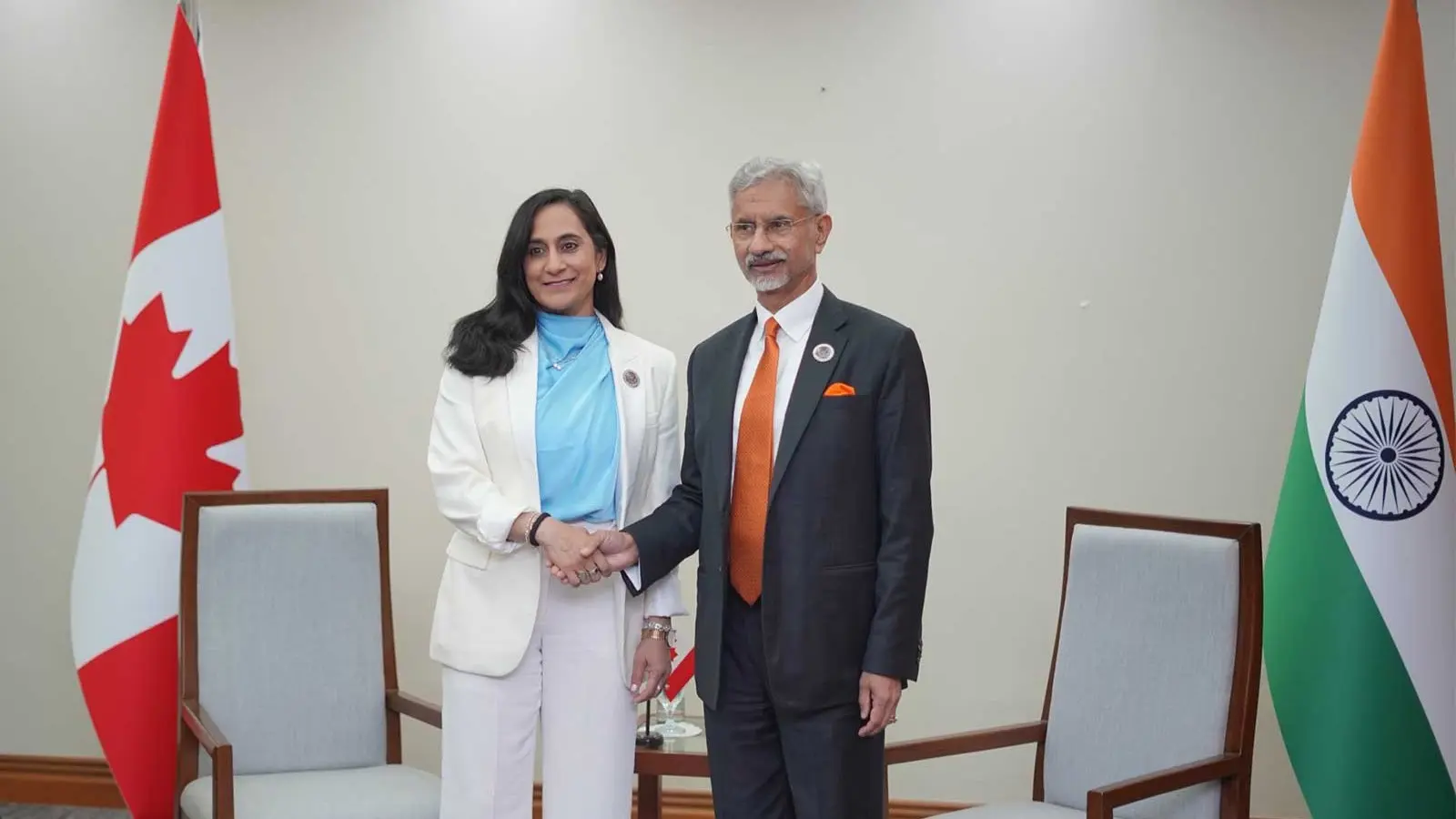
External Affairs Minister S. Jaishankar held a telephone conversation with his Canadian counterpart, Anita Anand, on Monday, with discussions focusing on the state of bilateral relations between India and Canada as well as developments concerning the Ukraine situation. The conversation comes at a time when ties between the two countries have shown signs of renewed momentum following a period of diplomatic strain, with both sides seeking to strengthen institutional engagement and expand cooperation across a range of areas.
Jaishankar described the conversation as a useful engagement, saying that he had spoken with Foreign Minister Anita Anand about bilateral cooperation as well as the situation in Ukraine. The latest ministerial-level interaction comes shortly after the annual Foreign Office Consultations (FOC) between India and Canada, which were held earlier this month in New Delhi. The consultations provided an opportunity for officials from both countries to review the progress made in bilateral relations and discuss ways to further advance cooperation.
The recent exchanges indicate a gradual strengthening of diplomatic engagement between New Delhi and Ottawa, with both sides placing greater emphasis on practical cooperation and regular dialogue. The Foreign Office Consultations were particularly significant in this regard, as they covered a broad range of issues spanning economic relations, energy, critical minerals, science and technology, education, security, defence, culture and consular affairs.
Foreign Office Consultations underline renewed engagement
The annual Foreign Office Consultations were held on September 2 at Hyderabad House in New Delhi. The Indian delegation was led by MEA Secretary (East) Rudrendra Tandon, while the Canadian side was headed by Deputy Minister of Foreign Affairs Arun Thangaraj.
According to the Ministry of External Affairs, the consultations took place against the backdrop of sustained momentum in India–Canada relations. The ministry pointed to the pace of high-level exchanges and progress across various areas of bilateral cooperation since June 2025 as evidence of improving engagement between the two countries.
Both sides reaffirmed the importance of India–Canada ties, emphasising the values and principles that underpin their relationship. These include shared democratic values, respect for sovereignty and territorial integrity, and a common commitment to the rule of law.
The consultations therefore represented more than a routine diplomatic review. They were also an effort to consolidate the progress achieved over the past year and establish a stronger institutional foundation for future engagement. Regular diplomatic consultations can help both countries maintain communication across multiple levels of government and ensure that bilateral cooperation continues even as the two sides address complex regional and global issues.
Focus on energy, critical minerals and emerging sectors
One of the key features of the consultations was the review of several institutional mechanisms established to facilitate cooperation in strategic and emerging areas.
Energy and critical minerals figured prominently in the discussions. These sectors have assumed increasing importance as countries around the world seek to strengthen the resilience of supply chains and diversify access to strategically important resources. For India and Canada, greater cooperation in these areas could open up opportunities for investment, technology partnerships and long-term economic engagement.
The two countries also reviewed cooperation in science and technology, another area with significant potential for expanding bilateral ties. Collaboration in research, innovation and technology can strengthen economic links while creating opportunities for universities, research institutions, companies and start-ups in both countries.
Education was also included in the discussions, reflecting the significant people-to-people links that have traditionally contributed to India–Canada relations. Academic exchanges, institutional partnerships and educational cooperation remain important components of the wider bilateral relationship.
In addition, the two sides discussed security and defence cooperation, culture, people-to-people ties and consular matters. The breadth of these discussions demonstrates that the relationship extends well beyond trade and diplomacy and encompasses a wide network of institutional and societal connections.
The MEA said both sides welcomed the progress made in strengthening institutional engagement and dialogue between the two governments. The emphasis on institutional mechanisms is particularly important as India and Canada work to establish a more predictable and sustained framework for cooperation.
Economic partnership remains a major priority
Economic engagement was another important focus of the discussions. India and Canada have expressed their intention to advance negotiations towards a Comprehensive Economic Partnership Agreement, with both sides working towards finalising the agreement before the end of the year.
The proposed economic partnership is expected to provide a stronger framework for expanding trade and investment between the two countries. Both governments have set an ambitious target of reaching bilateral trade of CAD 70 billion, equivalent to approximately INR 4.65 lakh crore, by 2030.
The trade target reflects the scale of economic opportunity that both countries see in their relationship. Strengthening commercial ties could help expand market access, facilitate investment and encourage greater participation by businesses from both sides.
For India, deeper economic engagement with Canada could provide opportunities across sectors including energy, critical minerals, technology, education and financial services. For Canada, India represents a large and rapidly expanding market, while Indian businesses and investors can benefit from Canada’s resources, technology ecosystem and access to wider global markets.
The push towards a comprehensive economic partnership also reflects a broader effort to give the bilateral relationship a stronger economic foundation. Regular engagement between policymakers and business communities is expected to play an important role in translating political intent into concrete commercial outcomes.
Finance ministers discuss opportunities for investment
The latest diplomatic engagement follows recent economic discussions between the two countries at the ministerial and business levels.
Last month, Finance Minister Nirmala Sitharaman highlighted the potential for strengthening financial cooperation during the India–Canada Business Roundtable in Toronto, where she engaged with her Canadian counterpart, Francois-Philippe Champagne.
The Ministry of Finance said Sitharaman highlighted the fresh momentum in India–Canada economic engagement and called for translating that momentum into deeper financial-sector cooperation and long-term investment partnerships.
Her remarks underscored the importance of the financial sector in supporting broader economic ties. Greater collaboration in banking, investment, financial services and capital markets could provide additional momentum to bilateral commerce and create avenues for long-term partnerships between businesses and financial institutions.
The business roundtable also reflected the growing role of the private sector in the bilateral relationship. While government-to-government engagement remains central to diplomacy, stronger participation by businesses and investors can help broaden the economic base of India–Canada ties and generate tangible outcomes.
Ukraine situation also discussed
Alongside bilateral cooperation, Jaishankar and Anand also exchanged views on the situation in Ukraine. The inclusion of the issue in the ministerial conversation highlights the broader international and geopolitical dimensions of India–Canada engagement.
The Ukraine conflict continues to remain an important issue in international diplomacy, with countries assessing its implications for regional stability, global security, energy markets and the international economic environment. India and Canada have their own perspectives and priorities on a range of international developments, making regular diplomatic communication important for understanding each other’s positions.
The latest discussion provides an opportunity for the two sides to maintain dialogue on major global developments while continuing to focus on areas where bilateral cooperation can deliver practical outcomes.
Building a stable and forward-looking relationship
Taken together, the recent ministerial conversation, Foreign Office Consultations and economic engagements point towards a broader effort by India and Canada to strengthen the foundation of their bilateral relationship.
The focus on institutional dialogue, economic cooperation, critical minerals, energy, science and technology, education, defence and people-to-people ties demonstrates the breadth of opportunities available to both countries. At the same time, discussions on the Ukraine situation and other international developments underline the importance of maintaining regular communication on global issues.
The commitment to advance negotiations for a Comprehensive Economic Partnership Agreement, alongside the ambitious target of CAD 70 billion in bilateral trade by 2030, gives the economic relationship a clear long-term objective. Increased engagement between finance ministries, businesses and investors could further support this goal.
The renewed emphasis on institutional mechanisms is equally significant. Strong and consistent diplomatic channels can help both countries address differences, deepen areas of convergence and sustain cooperation across a wide range of sectors.
As India and Canada continue to build on the momentum of the past year, the latest exchanges suggest that both sides are seeking a more structured, practical and forward-looking relationship. Continued high-level engagement, stronger economic partnerships and regular dialogue on regional and global developments could provide the basis for further consolidation of bilateral ties in the years ahead.