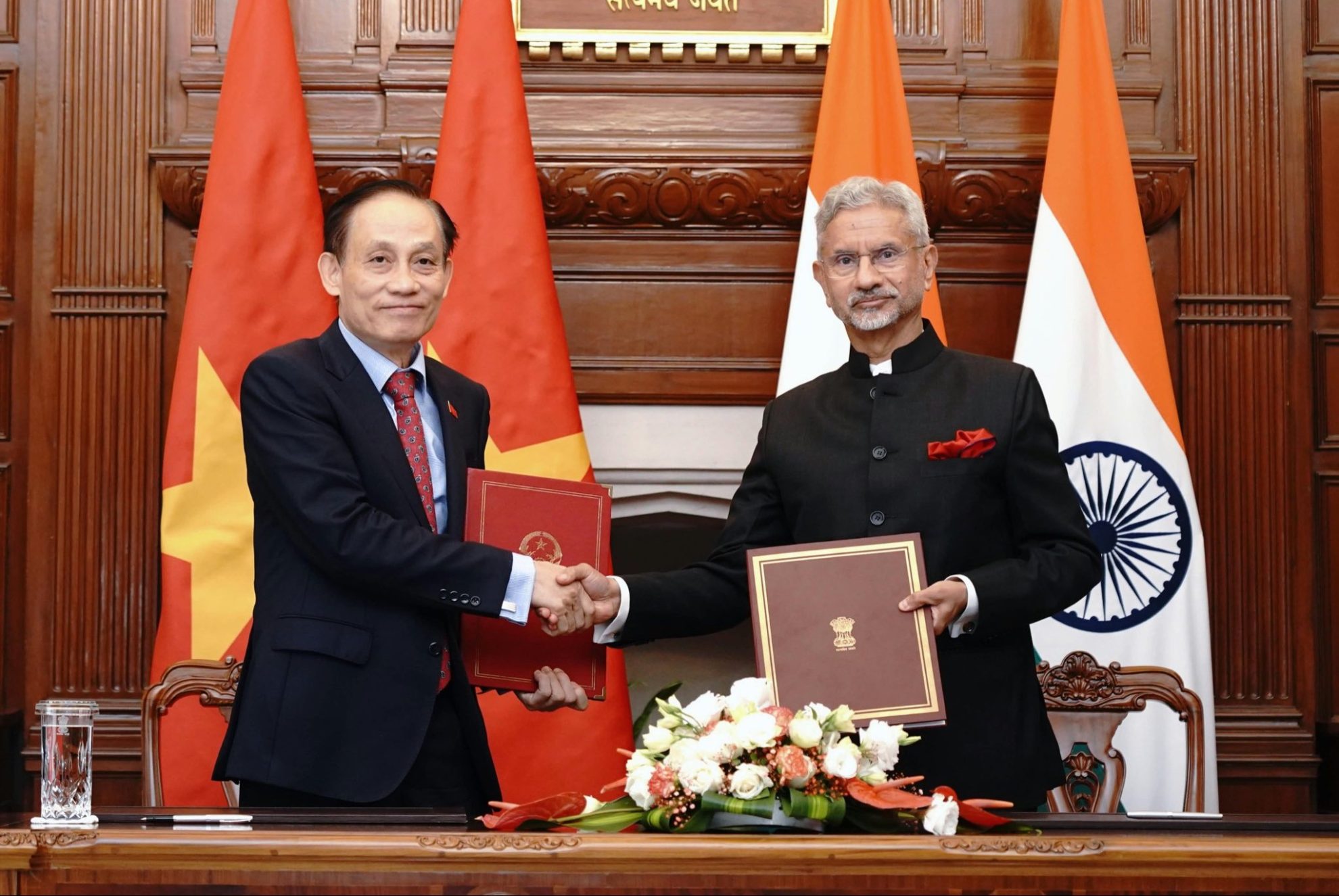
External Affairs Minister Dr S. Jaishankar and Vietnam’s Minister of Foreign Affairs Le Hoai Trung reviewed the full spectrum of India–Vietnam bilateral relations during the 19th India–Vietnam Joint Commission Meeting (JCM) on Trade, Economic, Scientific and Technological Cooperation in New Delhi on Monday. The meeting reaffirmed the steady momentum in the India–Vietnam Enhanced Comprehensive Strategic Partnership and provided an opportunity for the two sides to assess ongoing cooperation while identifying new areas for deeper engagement.
The discussions were described as productive and outcome-oriented, with the two ministers focusing on strengthening bilateral relations and advancing cooperation across a wide range of areas of mutual interest. The meeting also provided an important platform to translate the political leadership’s shared vision into practical initiatives covering trade, investment, defence, connectivity, science and technology, energy and people-to-people relations.
The ministers noted that the recent high-level exchanges between India and Vietnam had imparted renewed momentum to bilateral ties. In particular, discussions between To Lam, General Secretary of the Communist Party of Vietnam and President of the Socialist Republic of Vietnam, and Prime Minister Narendra Modi, including during To Lam’s State Visit to India in May this year, were seen as providing further impetus to the relationship. These engagements have reinforced the shared commitment of both countries to expand cooperation across traditional as well as emerging sectors.
Broadening Defence and Security Cooperation
Defence and security cooperation remained an important component of the discussions. India and Vietnam have developed close and growing strategic ties in the defence domain, and both sides discussed the way forward for deepening this partnership.
Among the areas highlighted was cooperation through the co-production of Indian defence items, reflecting the growing scope for practical collaboration in defence manufacturing and capacity building. Such initiatives can contribute not only to strengthening the defence capabilities of both countries but also to promoting greater industrial linkages and technological cooperation.
The two sides also reaffirmed the importance of continued engagement on broader security issues and recognised defence cooperation as an integral pillar of the Enhanced Comprehensive Strategic Partnership.
Expanding Trade, Investment and Supply Chains
Economic engagement featured prominently during the Joint Commission Meeting, with both sides discussing measures to further expand bilateral trade and investment and develop mutually beneficial and resilient supply chains.
The ministers emphasised the importance of enhancing market access, particularly for Indian marine and agricultural products and pharmaceuticals in Vietnam. Greater market access in these sectors is expected to create additional opportunities for businesses and strengthen commercial links between the two countries.
The discussions also covered ways to facilitate greater investment flows and encourage closer economic engagement between Indian and Vietnamese enterprises. With bilateral trade continuing to grow, the two countries have significant scope to diversify and deepen economic cooperation across established and emerging sectors.
According to the Ministry of External Affairs, India–Vietnam bilateral trade crossed USD 16 billion in 2025–26, registering growth of more than 10 per cent year-on-year. India’s exports to Vietnam stood at approximately USD 6.11 billion, while Vietnam’s exports to India were approximately USD 10.35 billion. The trade figures underline the increasing importance of the economic relationship and the potential for further expansion.
Connectivity, Energy, Science and Technology
The two ministers also discussed the need to strengthen financial, port and air connectivity between India and Vietnam. Improved connectivity is central to facilitating trade, investment, tourism and business-to-business interaction, while stronger financial links can support the broader expansion of commercial activities.
In addition, the two sides explored new opportunities in nuclear energy and the space sector. These emerging areas represent significant potential for long-term scientific and technological cooperation and reflect the growing ambition of the bilateral partnership.
The discussions highlighted the importance of expanding cooperation beyond traditional sectors and leveraging each country’s strengths in advanced technologies, scientific research and innovation. Such collaboration can contribute to new economic opportunities while supporting shared development priorities.
Maritime Cooperation, Capacity Building and Heritage
India and Vietnam also discussed cooperation on standards for seafarers, an area of significance given the maritime orientation of both economies and their growing engagement in the Indo-Pacific region. Strengthening cooperation in this domain can contribute to skill development, professional mobility and greater alignment of standards.
Heritage conservation was another area highlighted during the meeting. The issue reflects the deep historical and civilisational connections between India and Vietnam and offers an important avenue for cultural cooperation alongside the strategic and economic dimensions of the relationship.
The two sides also emphasised capacity building and the strengthening of people-to-people ties. Such initiatives are important for ensuring that the bilateral relationship extends beyond government-to-government engagement and develops deeper links among institutions, professionals, students and communities in both countries.
Yoga and the India–Vietnam Friendship Year
The growing popularity of Yoga in Vietnam was welcomed by both sides, underscoring the strength of cultural exchanges between India and Vietnam. Yoga has emerged as an important symbol of India’s cultural outreach and has contributed to greater public-level engagement in Vietnam.
Looking ahead, the two countries agreed to observe the coming year as the Year of India–Vietnam Friendship, marking 55 years of diplomatic relations. The anniversary is expected to provide an important opportunity to celebrate the longstanding relationship and showcase the breadth of bilateral cooperation through cultural, educational and public diplomacy initiatives.
The focus on friendship and people-to-people connections complements the broader strategic partnership and highlights the importance of shared cultural understanding in sustaining long-term bilateral ties.
Cooperation in the Indo-Pacific
Vietnam’s engagement under India’s Indo-Pacific Oceans Initiative (IPOI) was also welcomed. India and Vietnam share a common interest in maintaining a free, open, inclusive, peaceful and rules-based Indo-Pacific, and their cooperation in this framework provides an additional avenue for engagement on maritime and regional issues.
The two ministers exchanged views on regional and global developments of mutual interest and reaffirmed their commitment to closer coordination in regional and multilateral fora. Their discussions reflected the growing convergence between India and Vietnam on a range of strategic issues and their shared interest in strengthening cooperation in international platforms.
As two important partners in the Indo-Pacific, India and Vietnam have considerable potential to work together on maritime security, connectivity, sustainable development and regional stability. Greater coordination can also contribute to strengthening institutional cooperation and promoting common interests in multilateral settings.
Vietnam as a Key Pillar of India’s Act East Policy
Vietnam occupies a central place in India’s Act East Policy and remains one of India’s key strategic partners in Southeast Asia. The relationship is rooted in longstanding civilisational and historical linkages and has steadily expanded into a broad-based partnership encompassing political, strategic, economic, defence, scientific, cultural and people-to-people cooperation.
The India–Vietnam Enhanced Comprehensive Strategic Partnership continues to grow across both established and emerging areas. The regular convening of the Joint Commission reflects the importance attached by both governments to institutional mechanisms for reviewing progress, addressing challenges and identifying new opportunities.
The 19th Joint Commission Meeting demonstrated that the India–Vietnam partnership is entering a phase of increasingly broad-based and practical cooperation. From defence manufacturing and trade to connectivity, emerging technologies, energy, heritage and cultural exchanges, the two countries are seeking to strengthen both the strategic foundation and the economic depth of their relationship.
The ministers expressed satisfaction with the upward and growing trajectory of bilateral relations and agreed to convene the next Joint Commission Meeting at a mutually convenient date. This commitment underscores the importance of sustained high-level engagement in advancing the shared objectives of both countries.
As India and Vietnam prepare to commemorate 55 years of diplomatic relations through the Year of India–Vietnam Friendship, the partnership stands poised to enter a new phase of deeper strategic trust, expanded economic engagement and stronger people-to-people connections. The outcomes of the 19th Joint Commission Meeting provide a comprehensive framework for taking this relationship forward and reinforcing Vietnam’s role as a key pillar of India’s Act East Policy.
Source: https://ddindia.co.in/2026/09/jaishankar-vietnam-counterpart-le-hoai-trung-review-full-spectrum-of-india-vietnam-ties/ | https://www.mea.gov.in/press-releases?dtl/41794/19th_IndiaVietnam_Joint_Commission_Meeting_JCM_on_Trade_Economic_Scientific_and_Technological_Cooperation