
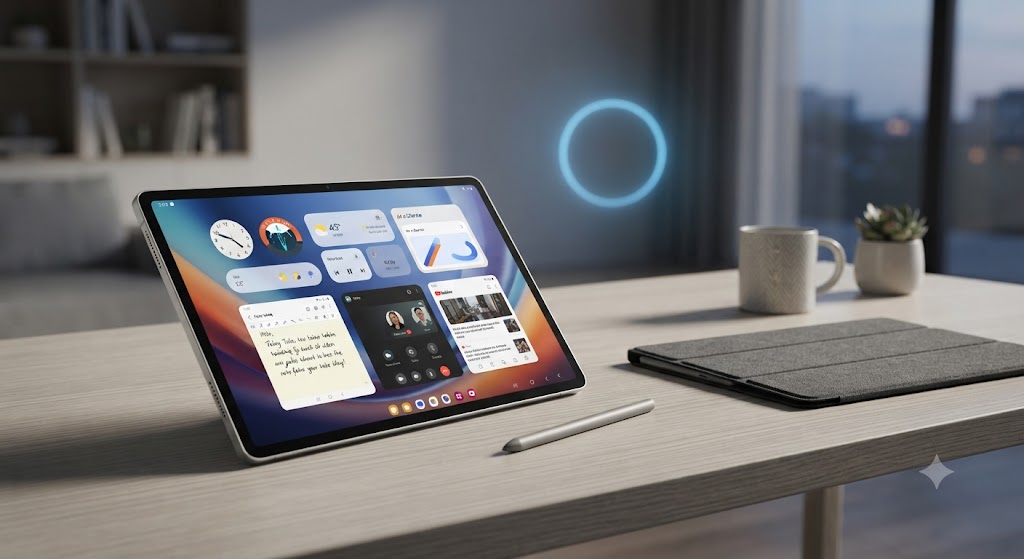
After a 15-year reign as the undisputed king of ultra-budget tablets, Amazon is fundamentally rewriting its hardware strategy. On Thursday, the tech giant officially discontinued its longstanding Fire tablet lineup, replacing it with a completely new family of premium “Alexa Tablets”. The strategic overhaul marks the most significant shift in Amazon’s devices ecosystem in a decade, abandoning the deeply restricted Fire OS in favor of full Android with native Google Play Store access.
This pivot represents far more than a simple rebrand. Driven by devices chief Panos Panay and CEO Andy Jassy, Amazon is steering its hardware division away from low-margin, entry-level devices toward a premium computing experience designed to challenge Apple and Samsung directly. With global tablet market share dwindling to a mere 1.9 percent, the move underscores a realization within Seattle headquarters: the race to the bottom of the pricing barrel is no longer sustainable.
The Hardware: A Leap into the Premium Tier
The new Alexa Tablet lineup entirely sheds the utilitarian, plastic-heavy aesthetic of the Fire series in favor of sleek, aluminum-bodied chassis that project a distinctly high-end feel. Launching across North America on October 14, the portfolio introduces a tiered pricing structure that more than doubles the entry cost of its predecessors.
The family features three distinct models:
- Alexa Tablet 8: The new entry point into Amazon’s ecosystem, priced at $229.99.
- Alexa Tablet 11: The mid-tier option, commanding $329.99.
- Alexa Tablet 12 Pro: The flagship offering starts at $499.99 and peaks at $549.99 for the premium Nanomatte display variant.
The technical specifications of the 12 Pro highlight Panay’s influence—a former Microsoft executive known for designing the sleek Surface lineup. At $549.99, the flagship 12 Pro features a 12-inch display boasting a fluid 120Hz refresh rate and full stylus support. Under the hood, it is powered by a robust MediaTek Dimensity 8400 processor, offering configurations up to 16GB of RAM and 256GB of onboard storage.
Perhaps its most striking hardware innovation is the Nanomatte display. According to Amazon, this screen utilizes a photolithography process developed in partnership with Corning to etch a pixel-aligned texture directly into the glass. Unlike standard matte screens that merely sandblast the surface and scatter light unevenly, this sub-pixel etching drastically reduces glare while preserving the ~275 PPI display’s color accuracy and pristine detail. Combined with Dolby Atmos speakers and a sleek magnetic keyboard case, the 12 Pro is unapologetically positioned to court productivity users and creatives.
The Software Revolution: Full Android and Google Play
Hardware aside, the most consequential news for consumers and developers is Amazon’s surrender in the operating system wars. For over a decade, Fire tablets ran on Fire OS, a heavily modified, “forked” version of Android. While it allowed Amazon to strictly control the user experience and drive traffic toward its own storefronts, it fundamentally crippled the devices by lacking the Google Play Store. Users were forced to rely on Amazon’s notoriously sparse Appstore, missing out on crucial productivity apps, banking software, and standard Google services.
By abandoning the restrictive Fire OS and embracing full Android with native Google Play access, Amazon is instantly solving its hardware division’s biggest historical pain point. This concession transforms the Alexa Tablets from limited media consumption portals into highly versatile computing devices capable of running the exact same software ecosystem as premium Android hardware.
The AI Integration: Enter “Alexa+”
While Amazon is adopting Google’s app store, it remains fiercely protective of its on-device artificial intelligence. The new tablets are the very first hardware products to bear the Alexa brand name. They feature deep, system-level integration of “Alexa+”, an upgraded, generative iteration of Amazon’s digital assistant.
The cornerstone of this integration is a feature dubbed “On-Screen Intelligence”. Alexa+ is capable of contextually analyzing whatever is actively displayed on the tablet’s screen. If a user is reading a recipe, Alexa+ can parse the ingredients; if they are watching a video review of a product, the AI can seamlessly facilitate the shopping process right from the display.
This deep integration reveals the core of Andy Jassy’s monetization strategy. As component costs across the consumer electronics sector rise, hardware margins are inherently pressured. The Alexa Tablets are designed not just as computing devices, but as sophisticated, integrated smart home hubs that seamlessly drive high-margin retail sales directly through the interface.
A Necessary Risk
For years, the sub-$100 Fire tablet was a staple of holiday gifting and impulse buying. Yet, the strategy of selling cheap hardware to generate digital ecosystem engagement has yielded diminishing returns in an increasingly saturated market. By raising the price floor from $50 to $230 and pushing the ceiling closer to the $449-$1,199 pricing range of Apple’s iPad, Amazon is making a bold, necessary pivot.
The transition will undeniably alienate budget-conscious consumers who viewed the Fire line as the ultimate disposable screen for kids or casual reading. However, by finally pairing premium aluminum build quality with the unhindered freedom of the Google Play Store, Amazon has built its first tablet in a decade that genuinely demands to be taken seriously by tech enthusiasts.
* Conceptual illustration generated using AI