
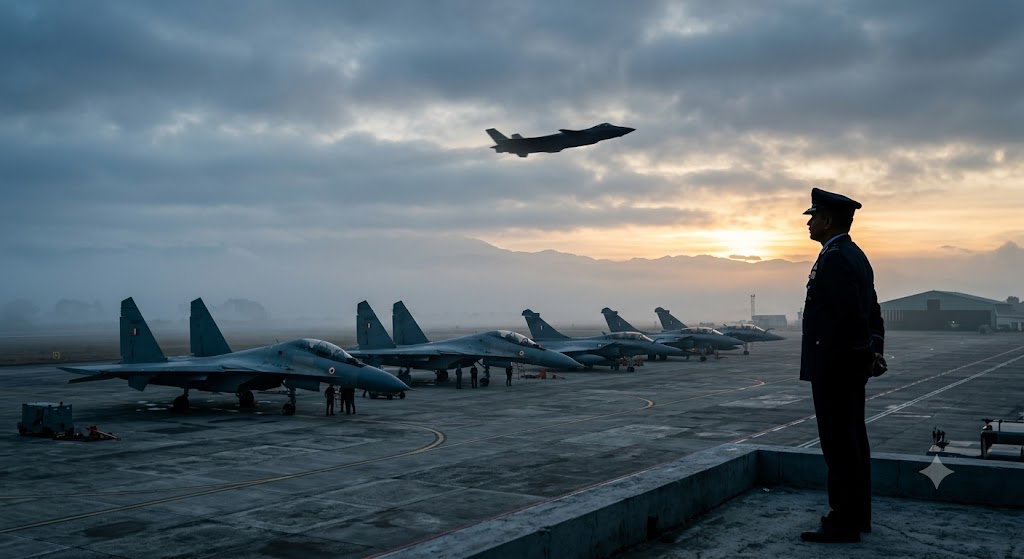
The Indian Air Force (IAF) is navigating a precarious transition, caught between an aging fleet, delayed domestic manufacturing pipelines, and a rapidly modernizing neighborhood. On Saturday, October 3, 2026, ahead of the 94th Air Force Day on October 8, IAF Chief Air Chief Marshal AP Singh delivered a blunt, unfiltered assessment of India’s air combat readiness. Addressing the media in his final annual press conference before his scheduled retirement at the end of the month, the Air Chief Marshal provided a sobering reality check regarding the structural bottlenecks hindering the IAF, while issuing a stark warning about the evolving aerial threats on India’s western and northern borders.
The Math of Deterrence: A Depleting Fleet
At the core of the IAF’s current predicament is a severe numbers game. Air Chief Marshal Singh explicitly noted that the force’s fighter squadrons have depleted to an alarming 29, dropping dangerously below the sanctioned ideal strength of 42.5 squadrons. Given the increasingly complex and hostile security environment in the subcontinent, he argued that the IAF actually requires even more than 42 squadrons to ensure absolute dominance.
To merely plug the immediate capability gaps and stop the squadron count from plummeting further, the IAF must induct between 36 and 40 new aircraft annually. This equates to raising two full fighter squadrons every single year. Achieving this induction rate is the only mathematical pathway for the Air Force to halt its decline and begin inching back toward its target of 42 combat squadrons.
The Atmanirbharta Balancing Act
Achieving this annual 40-aircraft induction rate requires a flawless domestic manufacturing pipeline, an area where the defense ecosystem is currently falling short. Singh did not mince words regarding these industrial hold-ups, stating, “There is some extra delay this time, and there is no doubt that it is going to hurt us”. He reiterated a fundamental military truth to underscore his frustration: “Technology delayed is technology denied”.
The IAF is currently counting heavily on the timely delivery of the indigenous LCA Tejas Mk-1A, the highly anticipated multi-role fighter aircraft (MRFA), and additional Sukhoi-30MKIs to shore up its fleet. While the Air Chief Marshal expressed full institutional support for the government’s push for indigenous defense manufacturing, he drew a firm red line regarding operational readiness. “Atmanirbharta is a necessity,” Singh stated, before delivering a crucial caveat: “But we can’t have atmanirbharata at the cost of our defence preparedness”. He noted that creating a self-reliant aerospace ecosystem cannot happen overnight, indicating that the pace of domestic production remains a significant hurdle.
The China-Pakistan Stealth Nexus
The most striking geopolitical warning of the briefing concerned India’s western borders. The IAF Chief acknowledged intelligence reports indicating that Pakistan is moving closer to acquiring fifth-generation stealth fighter jets from China. Even more alarming, Singh noted that there are credible reports of Pakistani pilots already undergoing advanced training on these platforms in China.
“Undoubtedly, this is a cause for concern,” he remarked. China’s rapidly expanding J-20 fleet and its development of export-oriented stealth platforms present a formidable challenge. A Pakistani air force equipped with Chinese stealth technology would significantly alter the balance of air power in the subcontinent, threatening to neutralize some of the qualitative and technological edges the IAF has historically maintained.
System Integration Over Single Platforms
Despite the looming stealth threat, the Air Chief Marshal refused to categorize the situation as a “no-go” for the Indian military. He stressed that a modern air war is not a simple comparison of individual aircraft spec sheets, where one stealth platform automatically defeats a legacy jet.
“We possess the necessary capabilities; after all, it is not just about a single platform, but rather how that platform is integrated into the entire system,” Singh explained. He pointed to the need for an “AI-augmented force,” noting that technologies like drones and loitering munitions are “evolutionary” tools that must be seamlessly woven into the same operational setup alongside manned fighters, rather than functioning as a separate drone force. By leveraging superior system integration, electronic warfare, and coordinated tactics, the IAF plans to counter individual stealth platforms with a highly networked combat environment.
The AMCA Imperative and Plan B
To secure long-term air dominance, India desperately needs to field its own fifth-generation fighter. Singh urged a massive, prioritized push for the indigenous Advanced Medium Combat Aircraft (AMCA) program. Yet, in a pragmatic nod to operational realities, he kept the door open for alternative solutions. “We need to push the AMCA program forward; if there are delays, we must make alternative decisions,” he warned. While the primary focus remains on the indigenous AMCA, Singh acknowledged that Russia has offered its Su-57 stealth jets to India, though no procurement decisions have been finalized. The message to domestic manufacturers was clear: if the indigenous pipeline stalls, the IAF will be forced to look outward to secure the skies.
Resolve in the Skies
In a poignant moment that underscored the psychological demands of aviation, Singh took time to praise the exceptional bravery of Indian pilot Captain Smit Machchhar, who recently survived a harrowing axe attack by his co-pilot aboard a Flydubai flight. “What our Indian pilot has done is exceptionally great. He showed presence of mind, physical resolve, and mental resolve. It is also a lesson for us,” the IAF Chief stated.
As Air Chief Marshal AP Singh prepares to hand over command, his final briefing serves as a strategic wake-up call to the Ministry of Defence and the domestic aerospace industry. The blueprint for India’s air dominance is clear: an unwavering commitment to inducting 40 new aircraft a year, a hyper-accelerated AMCA program, and a ruthless approach to system integration. With Beijing and Islamabad tightening their stealth collaboration, the window for administrative and manufacturing delays has officially closed.
* Conceptual illustration generated using AI