
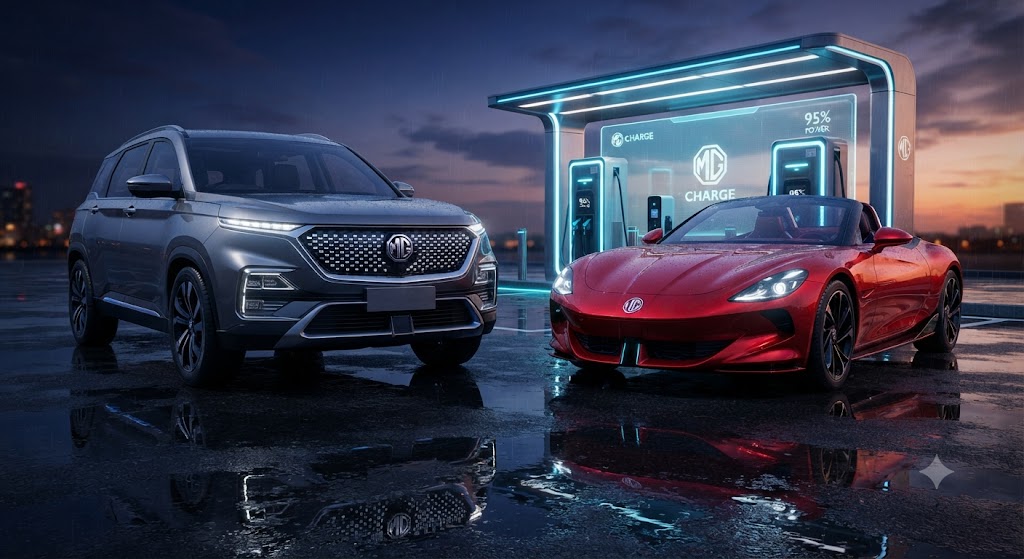
The Indian automotive landscape is undergoing a tectonic shift, and the electric vehicle (EV) segment is the primary fault line. While several legacy automakers are taking measured, cautious steps toward electrification, JSW MG Motor India has decided to press the accelerator to the floor. Armed with a newly fortified joint venture, a highly modular vehicle architecture, and a product blitz that includes both pure electric and plug-in hybrid models, MG Motor is executing one of the most aggressive new energy vehicle (NEV) strategies the Indian market has ever witnessed.
The company’s roadmap for 2026 and beyond reveals a profound understanding of the complex, diverse, and price-sensitive Indian consumer base. By attacking multiple price points, body styles, and powertrain preferences simultaneously, JSW MG Motor is no longer content with being a niche EV player—it is explicitly gunning for mass-market dominance.
Here is a comprehensive analysis of MG Motor India’s aggressive electric offensive, the technology underpinning it, and the new models set to disrupt the status quo.
The Foundation: The Revolutionary ADAPT Platform
At the heart of MG’s aggressive 2026 product strategy is a significant technological leap: the introduction of the MG ADAPT platform.
In the automotive industry, platforms dictate destiny. Developing a bespoke electric vehicle from scratch is astronomically expensive. The ADAPT architecture solves this by providing a highly scalable, modular foundation engineered specifically to accommodate both Battery Electric Vehicle (BEV) and Plug-in Hybrid Electric Vehicle (PHEV) powertrains.
This flexibility is a massive strategic advantage. It allows JSW MG to rapidly localize production, share critical components across multiple vehicle classes, and drastically reduce the time-to-market for new models. By utilizing a single foundational architecture, the company can seamlessly pivot its production lines to meet shifting consumer demands, whether buyers are clamoring for pure electric city cars or long-range plug-in hybrids for cross-country travel. The ADAPT platform is the industrial muscle enabling MG’s rapid-fire product launches this year.
The Hector Tomahawk: Disrupting the Electric SUV Space
The most potent weapon in MG’s current arsenal is the recently launched MG Hector Tomahawk EV. Unveiled to extreme fanfare, this three-row, seven-seater electric SUV represents a direct assault on the burgeoning premium electric utility segment.
Based heavily on the globally successful Wuling Eksion (also known as the Starlight 560 in other markets), the Hector Tomahawk EV has been heavily localized for Indian tastes and road conditions. With a highly aggressive introductory price of ₹19.49 lakh, the Tomahawk EV massively undercuts its primary competition.
The vehicle is explicitly designed to steal market share from heavyweights like the Mahindra XEV 9S and the Tata Harrier EV. While the Mahindra XEV 9S utilizes a rear-wheel-drive, rear-motor setup, the Tomahawk utilizes a front-mounted motor architecture, producing roughly 201 horsepower and 310 Nm of torque.
Beyond the drivetrain, the Tomahawk’s appeal lies in its packaging. Offering a massive 12.8-inch central touchscreen, a panoramic sunroof, and the inherent spatial benefits of an electric skateboard chassis, it offers genuine three-row practicality. By pricing a seven-seat electric SUV below the ₹20 lakh threshold, JSW MG has effectively erased the “EV premium,” forcing legacy manufacturers to urgently rethink their pricing strategies.
The Pragmatic Bridge: The Push for Plug-In Hybrids (PHEVs)
Perhaps the most fascinating aspect of MG’s aggressive 2026 strategy is its refusal to rely solely on battery electric vehicles. Recognizing that India’s public fast-charging infrastructure remains patchy outside of Tier-1 metropolitan hubs, MG is pioneering a massive push into Plug-in Hybrid Electric Vehicles (PHEVs).
Using the same ADAPT platform that underpins the Tomahawk EV, MG is rolling out PHEV variants designed to offer the “best of both worlds.” These vehicles feature a substantial battery pack capable of delivering over 100 kilometers of pure, silent, zero-emission electric driving—more than enough for the average daily urban commute. However, they are paired with a traditional internal combustion engine, extending the total driving range to over 1,000 kilometers and completely eliminating highway range anxiety.
This is a highly calculated move. JSW MG is targeting traditional large diesel-automatic SUVs, aiming to price its PHEV offerings within a razor-thin ₹1.5 lakh margin of popular diesel models like the Mahindra XUV 7XO. By doing so, MG is offering a cleaner, more refined, and cheaper-to-run alternative to diesel, without forcing buyers to compromise on cross-country capabilities.
Expanding the Footprint: Cloud, Cyberster, and the Indulge Edition
MG’s aggressiveness is not limited to large SUVs; the company is systematically filling every conceivable niche in the electric vehicle market.
- The Accessible Urban Warrior: For the entry-level market, the highly anticipated MG Cloud EV is set to disrupt the sub-₹15 lakh space. Slotting comfortably below the ZS EV and above the ultra-compact Comet, the Cloud EV brings premium design and practicality to the masses, putting it in direct contention with the Tata Punch EV and the Citroen eC3.
- Elevating the Windsor: MG is also maximizing the lifecycle of its existing models. The brand recently announced the MG Windsor EV Indulge Edition. This special edition focuses on high-end cosmetic and cabin enhancements, featuring a unique Shadow Gold exterior, blacked-out aesthetic elements, and luxurious “Aero Lounge” seating that reclines up to 135 degrees, catering to the chauffeur-driven corporate segment.
- The Halo Car: To solidify its brand prestige, MG is bringing the Cyberster Electric Roadster to Indian shores. Expected to be priced around ₹55–65 lakh, this low-slung, high-performance convertible is less about volume and more about showcasing MG’s ultimate engineering prowess, serving as a powerful technological statement at the top of the market.
The JSW Advantage: Scale, Capital, and Localization
This aggressive multi-front war would be impossible without the massive structural changes that occurred behind the scenes. The joint venture with the JSW Group has injected massive capital and local manufacturing expertise into MG Motor India.
The JSW partnership essentially guarantees that MG is no longer overly reliant on imported completely knocked down (CKD) kits. By deeply localizing the ADAPT platform and battery assembly, the company can shield itself from global supply chain shocks and import tariffs, directly translating those savings into the aggressive sub-₹20 lakh pricing seen on the new Hector Tomahawk EV.
Furthermore, JSW’s deep pockets are accelerating MG’s supplementary infrastructure. Launching cars is only half the battle; servicing them is the other. MG is simultaneously scaling up its localized service networks and expanding its proprietary charging ecosystem to support the massive influx of new vehicles expected over the next 24 months.
Conclusion: Redefining the EV Transition
For years, the Indian electric vehicle market was defined by a cautious, step-by-step evolution. JSW MG Motor India’s 2026 roadmap has fundamentally shattered that paradigm. By launching an aggressive mix of affordable compact EVs, heavily localized seven-seater electric SUVs, and highly practical plug-in hybrids, MG has cornered the market from almost every conceivable angle.
The launch of the Hector Tomahawk EV at a highly disruptive price point is a clear declaration of intent. MG is no longer testing the waters; it is actively attempting to flood the market. For Indian consumers, this aggressive strategy is a massive victory, promising a future of diverse, technologically advanced, and aggressively priced green mobility options. For MG’s competitors, the message is stark: adapt immediately, or risk being left behind in the silent revolution.
* Conceptual illustration generated using AI