
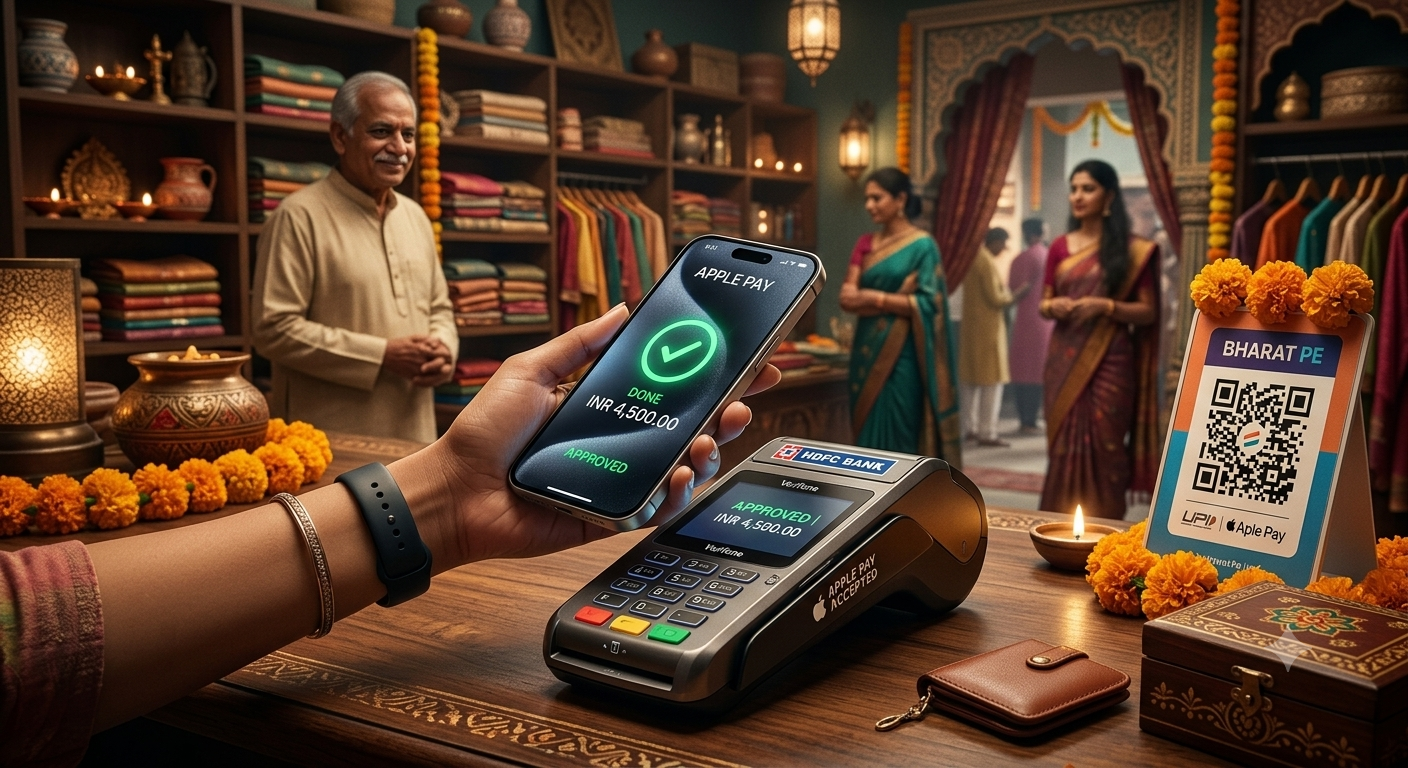
For over a decade, Indian iOS users have watched from the sidelines as Apple rolled out its flagship native payment solution across the globe. After years of regulatory hurdles, data localization debates, and complex banking negotiations, the wait officially ended on September 30, 2026. Apple has formally launched Apple Pay in India, marking a major milestone for the country’s premium digital payments landscape. However, while the arrival of the service brings the much-coveted tap-and-pay convenience to the Apple Wallet, a closer look at the initial rollout reveals a calculated, highly targeted strategy that deliberately avoids immediate confrontation with the nation’s dominant Unified Payments Interface (UPI) infrastructure.
The Launch Mechanics: Axis Bank Takes the Lead Apple’s foray into the Indian market is characterized by a measured, exclusive initial partnership rather than a massive, all-encompassing rollout. Starting September 30, iPhone, iPad, and Apple Watch users can activate the service natively. According to early reports reviewed by The Hindu, the service is currently restricted exclusively to Visa and Mastercard credit cards issued by Axis Bank. Support for Mac devices is also confirmed to be arriving shortly.
Users can provision their eligible credit cards either directly through the Wallet app on their iPhone or by routing the setup via the Axis Bank application. Once authenticated, the system utilizes secure, device-based tokens rather than storing actual card numbers, maintaining full compliance with the Payment Card Industry Data Security Standard (PCI DSS). This allows customers to bypass cumbersome One-Time Password (OTP) authentications for supported transactions, replacing them with seamless Face ID or Touch ID verifications.
The Glaring Omission: No UPI Support at Launch The most critical takeaway from Apple’s debut is what is conspicuously missing: UPI support. In a country where QR codes are plastered on everything from luxury boutiques to roadside tea stalls, the decision to launch without UPI integration fundamentally limits Apple Pay’s immediate utility.
Integrating UPI requires explicit approval from the National Payments Corporation of India (NPCI) and necessitates a sponsor bank to route transactions. Apple has yet to finalize this complex process. As a result, Apple Pay currently functions strictly as a secure digital container for Axis Bank credit cards, operating primarily on NFC-enabled Point of Sale (POS) terminals. For early adopters attempting to use the service, acceptance remains a significant hurdle; a transaction might succeed at one merchant’s terminal but fail at another, even if the latter generally accepts contactless cards.
Targeting the Premium Segment By restricting the initial launch to credit cards, Apple is making a deliberate play for high-value transactions within its own premium hardware ecosystem. The strategy is clear: cater to the aspirational, affluent iPhone demographic that frequently utilizes credit cards for high-ticket purchases and international travel.
This demographic represents a highly lucrative slice of the payments pie. E-commerce platforms and payment aggregators have long noted the superior conversion rates associated with Apple’s native checkout. For instance, Razorpay reported that businesses utilizing Apple Pay for international checkouts saw up to a 58% lift in conversion rates and a 45% faster checkout process. By capturing the high-spending Axis Bank credit card user base, Apple is positioning itself to dominate premium online and contactless checkouts, even if it ignores the high-volume, low-value peer-to-merchant UPI sector.
The Competitive Landscape: Are Paytm and Google Pay Safe? The arrival of a tech behemoth like Apple inevitably raises questions about the future of incumbent market leaders. According to analysis by Sahi, established platforms like Google Pay and Paytm remain fundamentally insulated from immediate disruption.
Paytm’s dominant market position is secured by its deeply entrenched offline infrastructure. With millions of physical Soundbox devices and QR code scanners deployed across the country, Paytm’s merchant lock-in is incredibly robust. Furthermore, Paytm continues to show strong financial health, recently reporting a Q1 FY27 EBITDA of ₹203 crore—a 182% year-on-year increase—and seeing its stock surge to a 52-week high of ₹1,856.50 earlier in September. Because Apple Pay currently lacks UPI functionality and is confined to a niche demographic of Axis Bank cardholders, the near-term structural threat to Paytm’s ₹2,448 crore quarterly revenue engine is considered minimal.
However, the payments landscape will shift again on October 15, 2026, when the NPCI implements a 0.4% Merchant Discount Rate (MDR) on certain UPI transactions above ₹2,000. As monetization models for payment service providers evolve, Apple’s focus on the lucrative credit card segment may prove to be a highly resilient long-term strategy.
What Lies Ahead for Apple Pay in India? While Axis Bank enjoys the spotlight as the exclusive launch partner, the banking ecosystem is already preparing for expansion. Industry sources suggest that Apple is in advanced, ongoing discussions with both HDFC Bank and ICICI Bank—two institutions with significantly larger credit card portfolios than Axis Bank.
The true test for Apple Pay will come if and when it successfully integrates the UPI framework. Until Apple bridges that crucial gap, its payment service will remain a luxurious convenience for the few, rather than a daily necessity for the masses. Nevertheless, after 12 years of anticipation, the foundation has finally been laid. The walled garden has opened its gates to Indian financial infrastructure, and the premium digital payments war has officially entered its next chapter.
* Conceptual illustration generated using AI